
From the
Paris Review:
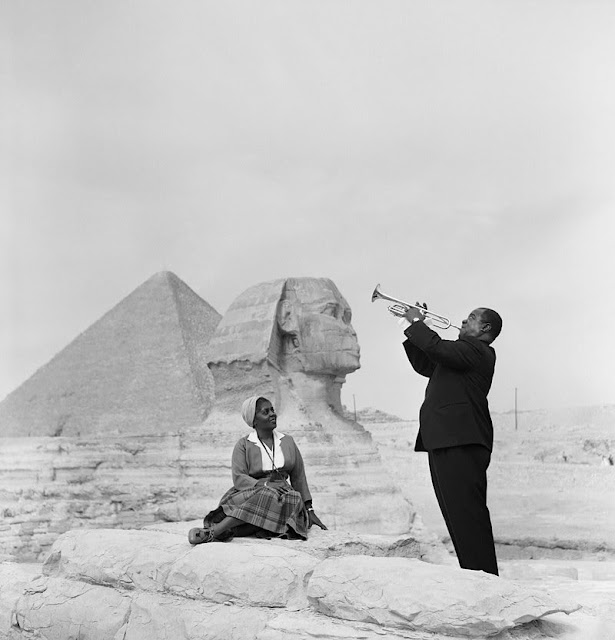
In a typical year, Louis Armstrong spent more than three hundred days on the road, bringing his music to audiences around the world. He always traveled with a steamer trunk designed to house two reel-to-reel tape decks and a turntable, and he carried a stash of music for his own listening pleasure, to while away the hours he spent in hotels and dressing rooms before and after each gig. Tapes being less fragile than LPs, and possessing longer recording capacity, he ultimately transferred much of his collection to seven-inch reels. He also made mix tapes of his favorite tunes. He liked musicians who prized melody, and his selections range from Glenn Miller to Jelly Roll Morton to Tchaikovsky. Occasionally he added commentary over the music or played along, and he made copies of his own recordings, to which (unlike many musicians) he enjoyed listening. But often he would just turn on the recorder to capture everyday conversations, whether he was hanging out at home in his living room with his wife Lucille, telling jokes backstage with band members, being interviewed by reporters, or entertaining fans.
When not pressing the valves on his trumpet or the record button on his tape recorder, Armstrong’s fingers found other arts with which to occupy themselves. One of them was collage, which became a visual outlet for his improvisational genius. The story goes that he did a series of collages on paper and tacked them up on the wall of his den, but Lucille, who had supervised the purchase and interior decoration of their house in Corona, Queens, objected. Armstrong decided to use his extensive library of tapes as a canvas instead, and the result is a collection of some five hundred decorated reel-to-reel boxes, one thousand collages counting front and back. The collages feature photographs of Armstrong with friends (like the snapshot captioned “Taken at Catherine and Count Basie’s swimming pool, at his birthday party, August 1969”) and with fans (Armstrong seems never to have refused a photo op or an autograph); congratulatory telegrams and clippings from reviews of his performances; a blessing from the Vatican (as reassembled by Louis, the first lines read: “Mr. and Mrs. Most Holy Father Louis Armstrong”); and cutouts from packages of Swiss Kriss herbal laxatives, which, judging from the label’s ubiquity in these pieces, were as much a staple of Armstrong’s daily life as playing the horn. Only occasionally do the collages indicate the musical content within; usually there is no correlation. Armstrong made generous use of various kinds of adhesive tape not only to attach images to each box but also to laminate, frame, or highlight them. The works are untitled and undated, but he was making them as early as the 1950s; in a letter from 1953 he wrote, “Well, you know, my hobbie (one of them anyway) is using a lot of scotch tape . . . My hobbie is to pick out the different things during what I read and piece them together and [make] a little story of my own.”
These little stories, illuminating and entertaining syntheses of Armstrong’s passions, now reside in the Louis Armstrong Archives at Queens College in Flushing, New York. They show how this very public man could turn his irrepressible creativity to the service of private amusement; the collages, one senses, were chiefly for Armstrong’s own enjoyment, like the tapes they housed. It seems equally clear that they took on a documentary significance for him—no more poignantly so than in the final collage, made after his return from the hospital following a serious illness in June of 1971. Armstrong died on July 6 of that year, at the age of sixty-nine. But one of the headlines he clipped, from the June 24 edition of the Orange County Register, quotes him as saying: “Tell all the cats the Choirmaster up there in Heaven will have to wait for old Louis.”



 most definitely recorded some of the more enjoyable and timeless Christmas music over many years. Here he takes us up to Harlem on Christmas night...
 on Amazon


