Showing posts with label Roberta Bayley. Show all posts

May 10, 2013

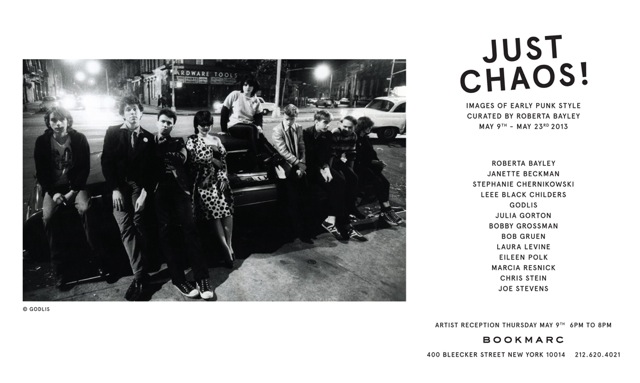
Just Daisy! Daisy checks out the Just Chaos! opening at Bookmarc


Our pal, Daisy, who usually checks in once in a while with her Letters From London, happens to be in NYC this week. Last night she attended the opening of the Just Chaos! photo show at Bookmarc in the west village. Here's what she had to say:

Met lots of punk rockers last night - ahem… maybe I shouldn't have started with the word "MET". Did you read the reviews of the Gala at the Metropolitan Museum's annual fundraiser Costume Ball the other day?  Someone on TV actually asked Vivienne Westwood who she was wearing,  and they didn't mean her Bradley Manning jewellery.


I read about the Gala in the Costa Coffee lounge at Heathrow. They have free newspapers. The Times of London loved it: "Crowns are the new Tiara's," they wrote. The Daily Mail hated it (probably because Lady Diana is dead and couldn't be there).  

I am a bit confused about it all.  It's not like the designers were meant to re-create 1976, were they?
I thought Madonna's outfit with her signature crucifix on her bottom was trying hard, and please, someone, give Sarah Jessica Parker something to eat.

Bookmarc is a clean and bright corner bookshop owned by Marc Jacobs. Yes the fashion designer.  I am glad he has a bookshop.  He used to work for Louis Vuitton.  Now there are 200 Marc Jacob stores in 80 countries. This show was organised by Roberta Bayley who invited Punk Photographers:  Janette Beckman, Stephanie Chernikowski, Laura Levine, Julia Gorton, Eileen Polk, Marcia Resnick, Lee Black Childers, Danny Fields, Godlis, Bobby Grossman, Bob Gruen, Chris Stein and Joe Stevens, to put a few photos each in the store windows and amongst the punk rock literature inside.

Sofia Coppola tins of wine and Pelligrino were served.

Because I had been a little thrown by the torrential rain in the morning, but decided to visit the local thrift shop to see if they had anything interesting, $15 got me a pair of red tartan trousers.  Perfect!
I didn't see a pair of converse at the show but I did have a wonderful time - this included:

John Leyland & Andy Schwartz
Speaking with John Leyland (nee SPIN now NYT) about going to the punk show at the Met.  We both hoped the Gala was successful even if the punk exhibit fails. I saw Leee Black Childers (another Warhol Factory man) but we couldn't chat because he was being interviewed all evening pretty much.

Randy Haecker
I admired Laura Levine's photographic career and she told me how she organises events at her shop upstate called The Mystery Spot.

Randy Haecker told me he's working on a Clash Box Set (I forget how many discs but there are quite a lot).  He had a Marc Jacobs bag and when asked to show-and-tell he didn't produce a shirt or a tie, but a book, nicely wrapped, by photographer SHEILA ROCK.  Sheila just had a book launch in London.

I met a real-life ballgirl for the Phillies baseball team:  Ms. Ronnie Norpel.  She's even written a book called Baseball Karma & The Constitution Blues

Howie Pyro & Jahn Xavier
I met Howie Pyro who told me his punk rock flyer collection is still up in the Bowery Electric and will be for a few more weeks. 

I stood with Jahn Xavier who could name most of the people on the sidewalk from his youth - and I mean YOUTH.  He was 16 when he played bass for Richard Hell.. he named the CBGB's waitresses amongst others...

My Smoking Life
I met a Jewish-Norwegian man who had given up smoking three days ago.  WELL DONE.  I may have said, it's a bit of a mystery why we smoke, isn't it? And he produced a typed - on a TYPEWRITER - paper - why he liked smoking.

The Huff Post team lead by Mark Sax were on the sidewalk.

Handsome Dick Manitoba and Handsome son Jake were present. 

Handsome Jake & Handsome Dick
It was warm.  It got dark.  Godlis took a last look at the window before heading off to his neighbourhood.

Someone said, "I can't believe I'm nearly 60."
"You have such great skin."
Someone else said, "That's because we don't go out in daylight.  Rock and roll isn't a daylight thing".

I hopped the uptown train with a good friend.  We talked about Dylan, and people we knew, and how we are going to raise some funds of our own, without mentioning google, internet, like it was 1976.

See more photos of the event here.

From left: Julia Gorton, Laura Levine, Bob Gruen, Godlis, Stephanie Chernikowski, Bobby Grossman, Marcia Resnick, Roberta Bayley, and Leee Black Childers.

Nov 3, 2009

More Bande à part plus Bob Gruen speaks


As mentioned this summer, the Bande à part book is out & available now. Just as a reminder, it features photos by featuring photography by Roberta Bayley, Leee Black Childers, Stephanie Chernikowski, Danny Fields, Godlis, Bobby Grossman, Gerard Malanga, Maripol, Billy Name, Anton Perich, and Marcia Resnick

As a part of the festivities, the Clic Gallery in Soho will be hosting an exhibition to highlight the photographers featured in the book from November 10 thru January 3. There is an opening reception on November 14.

November 10, 2009 - January 3, 2010
Opening Reception: Sat., Nov 14, 6-9pm

Clic Bookstore & Gallery
424 Broome Street, New York, NY 10013
Tue-Sun 12 pm - 7 pm
212-219-9308


(J. Rotten courtesy of BobGruen.com)

Also, this Saturday, as part of the Brooklyn Museum's Who Shot Rock & Roll? exhibit, none other than Bob Gruen will be appearing & talking about his life & career in photography. Details as follows:

Saturday, November 7th at 5:30 PM
Tickets are available free at the visitor center in the museum lobby at 5 PM
200 Eastern Parkway, Brooklyn, New York (718) 638-500
(NY Subway # 2 or 3 train to Eastern Parkway/Brooklyn Museum of Art)

Jul 29, 2009

Bande à part: New York Underground 60’s 70’s 80’s

Originally published overseas a couple of years ago, and touring internationally since as a gallery exhibition, the wonderful photography collection Bande à part will finally see the light of day here in the US in September thanks to Gingko Press.

A comprehensive expose of the New York Underground in the 60s, 70s, and 80s, Bande à parte is a collection of photographs taken by those who were the eyes in the darkness, the insiders among the outsiders of art.

What distinguishes this group is that they are not professionals in the sense that taking pictures wasn’t really a job, it was a compulsion, something they had to do. Billy Name was a major domo at the silver Warhol Factory, Gerard Malanga was a poet and Warhol’s painting assistant, Danny Fields was a mover and shaker in the record business, responsible for the management of such talents as Iggy and The Stooges, The Doors and The Ramones. Even those who were photographers by trade were not the kind who waited for assignments, they were self-taught anthropologists who wanted to document their time, their place. And clearly, these pictures tell their stories better than words ever could.

Features photographs by Lee Childers, Billy Name, Anton Perich, Maripol, Roberta Bayley, Godlis, Bobby Grossman, Danny Fields, Stephanie Chernikowski, Marcia Resnick, and Gerard Malanga.

It can be pre-ordered from Amazon right here.
See more photos here.

208 pages, Paperback, 9'' x 11 ¾'' (230 x 280 mm)
120 color and b/w illustrations, English
ISBN: 978-1-58423-272-8
$ 35.00


Jun 17, 2009

Looking at Music: Side Two (part two)

Just got back from MOMA and the Looking At Music: Side Two exhibit. While I'm glad for some of the folks I know who have stuff in the show, I have to say I was disappointed. Considering the venue, I expected more.

The show is much smaller than I would have guessed - corner of the second floor that isn't much bigger than my apartment. If you go, and I'm not suggesting that you don't, be prepared to check out some of the other exhibits going on just so you get your moneys-worth. Without trying to sound too cynical, it almost felt more like a marketing ploy by MOMA...by putting up some album covers, and displaying some rare magazines, they figure to attract a demographic that hasn't been visiting lately. There was a definite lack of depth to the whole thing. Been there, done that.

Previous shows of the same subject matter were much better - the Downtown Show in 2006, and the New Museum's East Village USA show back at the end of '04.

Jun 11, 2009

Reminder: Looking at Music: Side 2 - at The Museum of Modern Art

As I was kindly reminded by Mr. Godlis this morning, the Looking At Music: Side 2 exhibit has opened at MOMA, and Friday nights are free! Below is the extensive press release which gives a much better description of the event than I could ever give:

The Museum of Modern Art presents Looking at Music: Side 2, a survey of over 120 photographs, music videos, drawings, audio recordings, publications, Super 8 films, and ephemera that look at New York City from the early 1970s to the early 1980s when the city became a haven for young renegade artists who often doubled as musicians and poets. Art and music cross-fertilized with a vengeance following a stripped-down, hard-edged, anti-establishment ethos, with some artists plastering city walls with self-designed posters or spray painted monikers, while others commandeered abandoned buildings, turning vacant garages into makeshift theaters for Super 8 film screenings and raucous performances. Many artists found the experimental music scene more vital and conducive to their contrarian ideas than the handful of contemporary art galleries in the city. Artists in turn formed bands, performed in clubs and non-profit art galleries, and self-published their own records and zines while using public access cable channels as a venue for media experiments and cultural debates.

Looking at Music: Side 2 is organized by Barbara London, Associate Curator, Department of Media and Performance Art, The Museum of Modern Art, and succeeds Looking at Music (2008), an examination of the interaction between artists and musicians of the 1960s and early 1970s. Looking at Music: Side 2 is on view from June 10 to November 30, 2009, with an accompanying film series in The Roy and Niuta Titus Theaters to commence in September 2009.

The exhibition spans numerous forms of media by a diverse group of artists including: drawings by Patti Smith and photography by Dan Graham, Nan Goldin, and Jimmy DeSana; experimental video by James Nares; issues of influential zines and magazines including Search & Destroy, Interview, and Punk; posters designed by Adrian Piper and Collaborative Projects, Inc. (Colab); prints by Jenny Holzer, Betsey Johnson, and Bern Boyle; music videos with songs by Blondie and Suicide; record covers designed by Kim Gordon, Jean-Michel Basquiat, and Raymond Pettibon; music from Television, The Ramones, and Talking Heads; and live band footage from performances at Max’s Kansas City.

Barbara London states: “This exhibition shows how musicians and artists coalesced at a time when New York City, while financially struggling, seemed to incubate innovative ideas and facilitate the phenomenal success of a few, marking the transition into the next, more commercial decade of artists in New York City.”

Outside The Yoshiko and Akio Morita Gallery, Looking at Music: Side 2 is introduced through a title wall designed by the New York artist Laurie Anderson. Within the exhibition James Nares’s video, Game (1975), greets viewers at the exhibition’s entrance. Active in the 1970s on the Lower East Side as a Super 8 filmmaker and member of The Del-Byzanteens, Nares concocted a percussive, imaginary board game, performed with Seth Tillett, which he turned into the subject of his experimental film. Nares’s work is accompanied by a monitor displaying segments from Glenn O’Brien’s late 1970s Manhattan Public Access television show, TV Party. Equal parts party, talk show, video art, concert, and political action, TV Party took live television to a place it had never been before, including interviews with a number of the artists included in the exhibition. Also on display are drawings by Patti Smith and an audio station playing her song Hey Joe/Piss Factory (1974), considered to be the first punk rock record and funded by the photographer Robert Mapplethorpe. Two tracks from The Ramones, widely cited as the first punk rock group, play at a nearby audio station, including “Beat on the Brat” and “Blitzkrieg Bop” (1976). In vitrines, poetry from the musician Richard Hell and a record from the German artist Martin Kippenberger’s short-lived musical project with Christine Hahn and Eric Mitchell are on display.

The exhibition next focuses on the work of New York based Colab, a non-profit artist collective distinguished for political engagement and the co-opting of public spaces, including an abandoned building in the heart of Times Square in 1980. In a set of video monitors, works from Colab artists are on display, including Coleen Fitzgibbon, a founding Colab member and instigator of the Times Square Show, which housed socially themed artworks in a derelict Times Square building. With a background in 1960s structuralist cinema, Fitzgibbon’s Super 8 film transferred to video, Time (1975), is a nonstop visual flow of headlines and text, all drawn from an issue of Time magazine, with the effect of an incessant restlessness of the filmic frame. On a nearby monitor, the music video Frankie Teardrop (1978), set to the New York-based band Suicide, is on display. This coarsely-textured film-video hybrid combines super-imposed projector manipulations and high-end video post-production. An insightful collaboration between videomaker Paul Dougherty and Art-Rite zine editors Walter Robinson and Edit DeAk, the work interprets a strident song by Suicide about a poverty-stricken Vietnam vet pushed to the edge. These works are surrounded by posters, audio, and a video by Judith Barry, Richard Kern, and the New York band Sonic Youth and the work of Beth and Scott B.

Looking at Music: Side 2 next examines the cross-influence of hip hop and art in New York City, including the video of Rapture (1981) by Blondie. Rapture, the first video to incorporate elements from rap on MTV, opens with choreographer William Barnes dancing in a white suit and top hat in New York’s Upper East Side. Barnes is joined by Debbie Harry and her bandmates—easy-going, cross-over artists who bridged uptown and downtown scenes. In the final sequence of the music video, the band dances down a street passing Fab 5 Freddy and graffiti artists Lee Quiñones and Jean-Michel Basquiat in action. The video is accompanied by photographs of Basquiat’s graffiti work from the 1970s, by Peter Moore and Stephanie Chernikowski, and a large-scale drawing by the artist, Untitled (1981).

The exhibition concludes with images from five rock n’ roll photographers. Adjacent to a large-scale photographic collage of the work of Bob Gruen, adapted from the 2007 installation Rock and Roll Teenager’s Bedroom and measuring 7.5’ x 22.5’, the exhibition includes vitrines with photographs of Suicide by Godlis and Sonic Youth by Stephanie Chernikowski, along with additional photographs by Roberta Bayley and Marcia Resnick. On a monitor beside these works is Bob Gruen’s New York Death Cult (Live at Max’s Kansas City) (1976), featuring grainy footage from famed music club Max’s Kansas City, which captures the raw, immersive spirit of up-and-coming musicians of that era such as Patti Smith.

www.moma.org

Image: Godlis (American, born 1951). Blondie, CBGB’s. 1977. Black-and-white photograph. The Museum of Modern Art Library. Gift of the artist.
Related Posts with Thumbnails